Call now (+34) 658 82 83 76
 Book now

Nautical training in Marbella: learn to sail
Your mentor at sea: much more than obtaining a boating qualification
Are you passionate about the sea and looking to learn how to sail, improve your skills or even turn your passion into a professional career?
At La Romana Marbella, we believe that learning to sail is about much more than passing an exam and obtaining a certificate. It's about gaining knowledge, developing good judgement, building confidence and, above all, enjoying the sea safely.
We want to be your mentor at sea.
We would love to get to know you, understand your current level of experience and discover where you would like your sailing journey to take you.
Perhaps you have never been at the helm of a boat, have just purchased your first yacht, want to enjoy longer passages with your family or dream of becoming a professional skipper.
Whatever your ambitions, we can help you find the right path to achieve them.
We are officially qualified instructors through the Andalusian Institute of Sport (Instituto Andaluz del Deporte) and collaborate with some of the leading nautical schools in Andalusia. This allows us to provide personalised guidance and support throughout your training, both theoretical and practical.
We also have extensive hands-on experience sailing throughout the Mediterranean, the Atlantic and various international destinations, aboard motor yachts, sailing yachts and catamarans.
Because understanding the theory is one thing, but handling a challenging docking manoeuvre, interpreting changing weather conditions or making important decisions during an offshore passage is something entirely different.
Our goal is to help you become an independent, confident and responsible skipper.
Practical sailing training: develop real skills and confidence at sea
Holding a boating qualification doesn't necessarily mean feeling confident at the helm.
Many people who have obtained their Spanish PER licence or even more advanced qualifications still feel uncertain when carrying out certain manoeuvres.
Confidence comes from spending time on the water, gaining experience and gradually facing new situations.
That's why, in addition to helping you obtain official qualifications, we offer private sailing lessons and personalised practical training, entirely adapted to your needs.
You don't need to be preparing for an exam. You might simply want to become a better skipper.
Marina manoeuvres, docking and berthing
Manoeuvring inside a marina is often one of the most challenging aspects of boating, particularly when sailing with a small crew or dealing with crosswinds.
We can help you improve your skills in:
-
Alongside and stern-to berthing.
-
Docking and undocking manoeuvres.
-
Rafting alongside other vessels.
-
Boat handling in crosswinds.
-
Using bow and stern thrusters.
-
Manoeuvring single-engine and twin-engine boats.
-
Proper use of mooring lines and fenders.
-
Crew communication and coordination.
-
Handling boats in confined spaces.
Training can take place aboard our vessels or on your own boat, allowing us to focus on the specific situations you encounter in your home marina.
Anchoring techniques and safe anchorages
Anchoring correctly is one of the most important skills for enjoying boating safely.
We teach you how to select a suitable anchorage, assess weather conditions, calculate the appropriate anchor scope and ensure your anchor is holding securely.
We can also practise anchoring in windy conditions, approaching anchorages, operating the windlass and recovering the anchor safely.
Sailing techniques and sail trim optimisation
If you sail a yacht, we can help you better understand how your sails work and how to achieve greater efficiency and performance.
Our training can cover:
-
Mainsail and genoa trimming.
-
Improving upwind performance.
-
Downwind sailing techniques.
-
Adjusting sheets, travellers, halyards and sail controls.
-
Balancing the boat and managing heel.
-
Tacking, gybing and course changes.
-
Reefing and reducing sail area.
-
Sailing with a short-handed crew.
It's not simply about making the boat move. It's about understanding why it behaves the way it does and how to improve its performance.
Navigation, meteorology and safety at sea
We also offer practical sessions focused on navigation and passage planning.
We can help you improve your understanding of nautical charts, electronic navigation systems, route planning, weather forecasting, night watches and onboard safety procedures.
Everything is adapted to your experience and the type of sailing you want to undertake.
Offshore passages: gain experience and build your nautical miles
One of the best ways to improve as a sailor is to take part in real sailing passages.
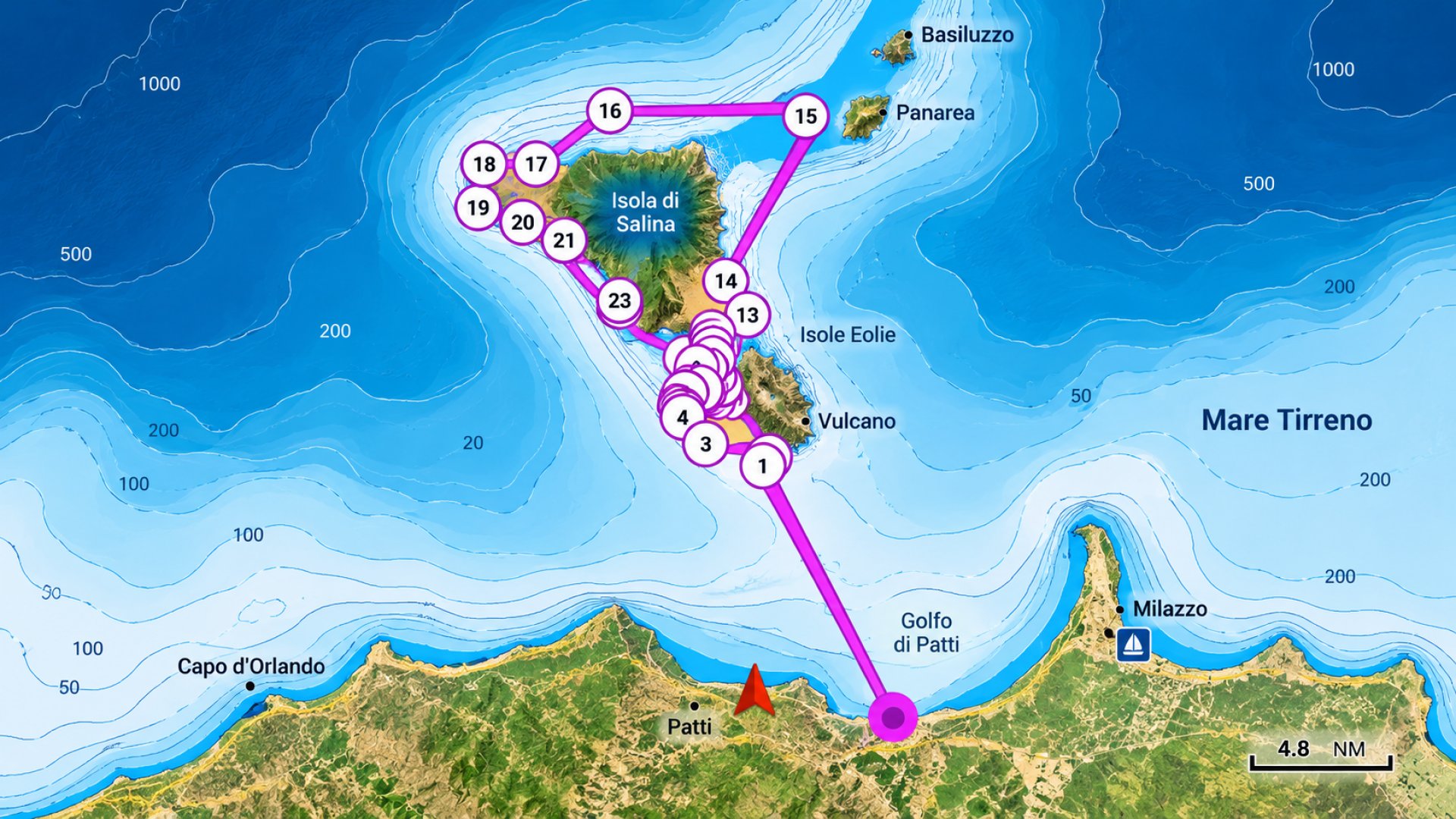
At La Romana Marbella, we organise sailing yacht and catamaran trips to destinations around the world, ranging from several days of coastal cruising to offshore passages requiring careful planning, watchkeeping and overnight sailing.
These experiences allow you to develop skills that are difficult to acquire during just a few hours of practical training.
Throughout the passage, you can actively participate in route planning, manoeuvres, navigation, watchkeeping and everyday life on board.
Some professional qualifications and certifications, such as the RYA Yachtmaster Offshore and the Spanish PPER, also require candidates to demonstrate previous sailing experience, sea time and nautical miles.
We can help you plan your sailing experience and participate in suitable passages to work towards these requirements.
Please bear in mind that, for nautical miles and sea time to count towards a particular qualification, they must meet the relevant certification requirements and be properly documented.
And if your main goal is simply to explore the world by boat, we also organise sailing holidays in extraordinary destinations, combining adventure, nature, navigation and the experience of living aboard.
From Mediterranean islands to Atlantic crossings, every journey is an opportunity to keep learning while enjoying our shared passion for the sea.
Spanish boating qualifications: which licence do you need?
Spain has several recreational boating qualifications, each with its own requirements and limitations regarding vessel size and distance from shore.
It is important to understand that all the qualifications explained below, from the basic Navigation Licence to Capitán de Yate, are recreational boating qualifications.
On their own, they do not authorise you to work professionally as a charter captain or commercial skipper.
Certain additional endorsements may allow specific limited professional activities, but if your goal is to work as a professional captain, you will need further training and certification.
Let's explore the different options and our recommendations.
Licencia de Navegación: your first step into boating
Commonly known by its former nickname, Titulín, the Spanish Navigation Licence (Licencia de Navegación) is the simplest and quickest way to start operating a boat.
It allows you to:
-
Operate recreational boats up to 6 metres in length, without a specific engine power limit, provided the power is suitable for the vessel.
-
Operate jet skis within the applicable restrictions.
-
Navigate up to 2 nautical miles from a port, marina or place of shelter.
-
Navigate during daylight hours only, between sunrise and sunset.
How do you obtain it?
You only need to complete a 6-hour course, consisting of 2 hours of theory and 4 hours of practical training.
There is no official examination.
You will also need a medical fitness certificate, similar to the one required for a driving licence. We can recommend medical centres where you can obtain it.
Our recommendation: this is a fantastic option if you want to rent small boats, enjoy a motorboat with friends or discover boating without investing too much time.
PNB: Patrón para Navegación Básica
The PNB (Basic Navigation Skipper) is the next level within the Spanish recreational boating qualification system.
Its main privileges include:
-
Operating recreational boats up to 8 metres in length.
-
Navigating up to 5 nautical miles from a port, marina or place of shelter.
-
Daytime and night-time navigation.
-
Operating jet skis within the applicable restrictions.
What do you need to obtain it?
You must pass an official theory examination and complete:
-
8 hours of practical safety and navigation training.
-
4 hours of radio communications training.
-
A medical fitness examination.
-
Optionally, 16 hours of sailing training to obtain the sailing endorsement.
Why don't we usually recommend the PNB?
Although it is a perfectly valid qualification, we believe that, in many cases, it makes more sense to go directly for the PER.
A significant part of the syllabus is shared, and with a relatively small amount of additional effort, you can obtain considerably greater boating privileges.
However, there is an interesting possibility: if you take the PER examination but do not pass every section, you may still qualify for a PNB pass, provided you achieve the required results in the relevant subjects.
You can then continue towards the PER by taking the remaining examination sections, according to the applicable regulations.
For this reason, the PNB can be a useful intermediate step, although we generally recommend aiming directly for the PER.
PER: Patrón de Embarcaciones de Recreo
In our opinion, the PER is the first truly comprehensive recreational boating qualification in Spain.
It is the qualification we recommend to most people who want to develop solid navigation skills, purchase a boat or enjoy greater independence at sea.
During your training, you will study navigation, maritime safety, meteorology, buoyage, nautical charts and maritime regulations.
A particularly important subject is the International Regulations for Preventing Collisions at Sea (COLREGs), known in Spain as RIPA.
You will learn to interpret navigation lights and shapes, recognise potential collision situations, understand the responsibilities of different vessels and take appropriate action to avoid collisions.
What does the PER allow you to do?
-
Operate recreational boats up to 15 metres in length.
-
Navigate up to 12 nautical miles from the coast.
-
Navigate between islands within the Balearic and Canary Islands.
-
Navigate both during the day and at night.
-
Operate jet skis within the applicable restrictions.
What do you need to obtain it?
In addition to passing the official theory examination, you must complete:
-
16 hours of practical safety and navigation training, usually over two days.
-
A 12-hour short-range radio operator course, including theory and practical training.
-
A medical fitness examination.
What if you want to sail?
You can complete the optional 16-hour sailing endorsement, which allows you to operate sailing yachts within the privileges of your qualification.
This endorsement only needs to be obtained once and remains valid when progressing to higher Spanish recreational boating qualifications.
Extending your PER privileges to 24 metres and passages to the Balearic Islands
One of the most interesting options is to complete an additional 24-hour practical passage.
This allows you to:
-
Operate recreational vessels up to 24 metres in length.
-
Navigate between mainland Spain and the Balearic Islands.
Our recommendation: a PER with the sailing endorsement and extended privileges is an exceptionally comprehensive qualification for recreational boating.
If you don't need to navigate more than 12 nautical miles offshore, apart from the authorised passage between mainland Spain and the Balearic Islands, and have no plans to pursue professional qualifications, it may be all you ever need.
Patrón de Yate: take your navigation further offshore
If you already hold the PER and want to take the next step, the Patrón de Yate (Yacht Skipper) qualification significantly expands your possibilities.
It is particularly interesting for sailors who want to undertake multi-day passages, navigate between countries or venture further offshore.
What does it allow you to do?
-
Operate recreational vessels up to 24 metres in length.
-
Navigate up to 150 nautical miles from the coast.
-
Undertake offshore passages within the privileges of the qualification.
What do you need?
-
Hold the PER qualification.
-
Pass the official Patrón de Yate theory examination.
-
Complete 48 hours of practical safety and navigation training, including passage-making and day and night watches.
-
Hold a valid medical fitness certificate.
You do not need to repeat the radio communications course completed for the PER.
You also do not need to repeat the sailing endorsement if you have already obtained it.
Regarding the medical certificate, a previous certificate may still be accepted if it remains valid under the applicable regulations.
Our recommendation: this is an excellent choice for sailors who already navigate regularly and want to begin planning more ambitious passages.
It is also a necessary step if you eventually want to obtain the Spanish Capitán de Yate qualification.
Capitán de Yate: recreational navigation without geographical limits
The Capitán de Yate (Yacht Captain) is the highest recreational boating qualification within the Spanish system.
It is particularly suitable for experienced sailors who want to undertake long